
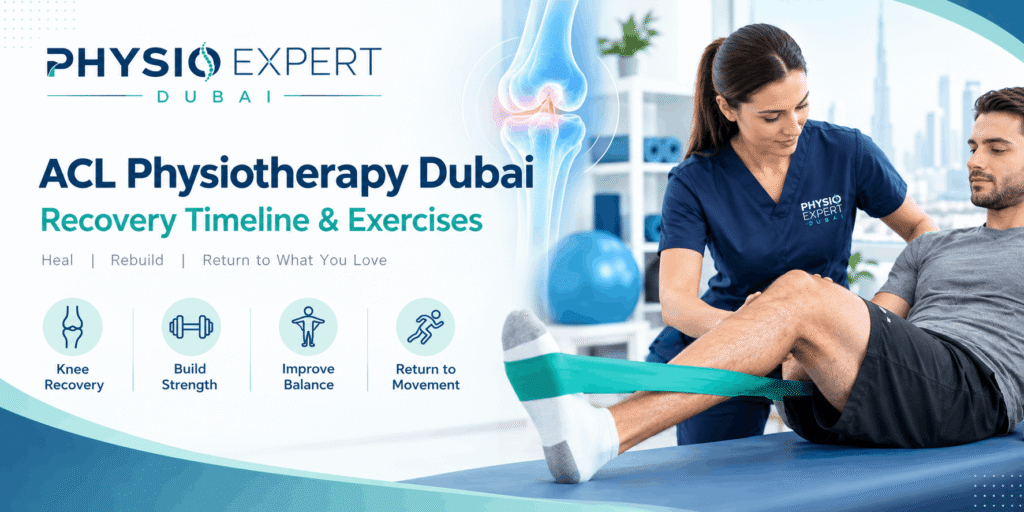
Anterior cruciate ligament (ACL) reconstruction is a significant knee procedure, particularly for people who want to return to running, gym training or competitive sport. Surgery is only one part of the recovery process. Structured rehabilitation is essential for gradually restoring knee movement, strength, balance and the ability to tolerate sporting demands.
ACL physiotherapy in Dubai can provide a progressive rehabilitation programme based on your surgery, current physical capacity, rehabilitation milestones and return-to-sport goals.
ACL recovery is not simply about waiting for the knee to feel better. An athlete may have less pain while still having significant strength or movement deficits. For this reason, rehabilitation generally progresses through several stages, with exercises becoming more challenging as the knee and surrounding muscles recover.
This guide explains what to expect after ACL surgery, the typical stages of ACL rehabilitation in Dubai, commonly used exercises, factors that influence recovery and how physiotherapy can support a gradual return to sport.
Important: ACL rehabilitation protocols vary according to the surgical technique, associated injuries and instructions from the surgical team. Your own surgeon and physiotherapist should determine your specific restrictions and progression.
What Is ACL Surgery?
The anterior cruciate ligament is one of the major ligaments that contributes to stability within the knee.
An ACL injury commonly occurs during activities involving:
- Sudden changes of direction
- Pivoting
- Landing from a jump
- Rapid deceleration
- Contact sports
- Skiing and similar activities
ACL reconstruction involves replacing the damaged ligament with a graft. The exact surgical approach and graft type can vary.
The rehabilitation process is designed to help the knee recover while gradually increasing its ability to tolerate everyday and sporting activities.
Why Is Physiotherapy Important After ACL Surgery?
After ACL reconstruction, the knee may experience:
- Pain
- Swelling
- Reduced range of motion
- Quadriceps weakness
- Reduced balance
- Altered walking
- Reduced confidence
- Difficulty with stairs
- Reduced ability to perform sports movements
ACL recovery physiotherapy helps address these limitations progressively.
Rehabilitation may focus on:
- Restoring knee movement
- Managing swelling
- Activating and strengthening muscles
- Improving balance
- Rebuilding lower-limb strength
- Improving movement control
- Developing sport-specific capacity
- Preparing for a safe return to activity
The goal is not simply to reduce pain. It is to rebuild the physical capacity required for your normal activities and, where appropriate, sport.
When Does ACL Physiotherapy Start?
The timing depends on the surgical procedure and the instructions provided by your surgeon.
In many rehabilitation programmes, physiotherapy begins relatively early after surgery.
The initial goals may include:
- Protecting the healing knee
- Controlling swelling
- Restoring appropriate movement
- Activating the quadriceps
- Learning safe walking techniques
- Following weight-bearing instructions
The first stage should not be rushed. The knee needs time to heal, and exercises should be appropriate for the surgical protocol.
ACL Recovery Timeline: What to Expect
Every patient recovers at a different rate. Therefore, ACL rehabilitation is better understood through milestones rather than a rigid calendar.
The following timeline is a general guide and does not replace your individual surgical rehabilitation protocol.
Phase 1: Early Recovery
Approximate period: First few weeks
The initial phase focuses on protecting the knee and establishing basic movement and muscle activation.
Common goals may include:
- Managing swelling
- Reducing discomfort
- Achieving appropriate knee extension
- Gradually improving knee flexion
- Activating the quadriceps
- Improving walking
- Following weight-bearing restrictions
Common Exercises
Depending on your surgical instructions, exercises may include:
- Ankle pumps
- Gentle knee range-of-motion exercises
- Quadriceps activation
- Straight-leg raises when appropriate
- Heel slides
- Gentle hip exercises
The exact exercises should be prescribed according to your surgical procedure.
Why Knee Extension Matters
Regaining appropriate knee extension is an important early rehabilitation goal.
Difficulty fully straightening the knee can affect walking mechanics and functional movement.
Your physiotherapist can guide you through appropriate exercises to work towards restoring movement without exceeding your surgical restrictions.
Phase 2: Restoring Movement and Basic Strength
Approximate period: Several weeks after surgery
As the knee settles and movement improves, rehabilitation generally becomes more active.
The focus may include:
- Improving knee flexion
- Maintaining full extension
- Increasing quadriceps strength
- Strengthening the hip
- Improving walking
- Developing basic balance
Possible Exercises
Depending on your rehabilitation programme, exercises may include:
- Stationary cycling when appropriate
- Mini squats
- Step-ups
- Bridges
- Leg strengthening exercises
- Calf raises
- Balance exercises
The intensity should be progressed gradually.
Phase 3: Progressive Strengthening
Approximate period: Following early rehabilitation
As movement improves, strength becomes increasingly important.
ACL reconstruction can result in significant quadriceps weakness. Restoring strength is important for normal function and for preparing the knee for more demanding activities.
Your programme may include:
- Squats
- Split squats
- Step-ups
- Step-downs
- Lunges when appropriate
- Hamstring strengthening
- Glute strengthening
- Calf strengthening
- Progressive resistance exercises
Exercises should become progressively more challenging as your physical capacity improves.
Phase 4: Balance and Neuromuscular Training
The ACL contributes to knee stability, and rehabilitation may include exercises designed to improve control of the lower limb.
Balance and neuromuscular exercises can involve:
- Single-leg balance
- Controlled step-downs
- Single-leg strengthening
- Movement-control exercises
- Landing preparation
- Dynamic balance
The objective is to improve the ability to control the knee and lower limb during increasingly demanding movements.
Phase 5: Running Progression
Running should not be introduced simply because a certain number of weeks have passed.
Before running, your physiotherapist may consider factors such as:
- Knee swelling
- Range of motion
- Strength
- Walking pattern
- Single-leg control
- Functional performance
- Medical clearance
A gradual running programme may begin with controlled jogging and progressively increase duration, speed and intensity.
If symptoms increase significantly, the programme may need to be modified.
Phase 6: Jumping, Landing and Agility
For athletes, ACL rehabilitation eventually needs to address the movements involved in their sport.
These can include:
- Jumping
- Landing
- Hopping
- Acceleration
- Deceleration
- Cutting
- Direction changes
- Reactive movements
These exercises should be introduced progressively.
The athlete needs to demonstrate sufficient strength and movement control before progressing to higher-demand activities.
Phase 7: Sport-Specific Rehabilitation
The final stages of ACL rehabilitation Dubai may involve exercises that reproduce the demands of your sport.
For example, a football player may need progressive exposure to:
- Sprinting
- Cutting
- Ball drills
- Acceleration
- Deceleration
- Changes of direction
A basketball player may require:
- Jumping
- Landing
- Lateral movement
- Rapid changes of direction
- Repeated high-intensity efforts
The rehabilitation programme should reflect the physical demands of the athlete’s sport.
What Exercises Are Used After ACL Surgery?
There is no single exercise programme that is appropriate for everyone after ACL reconstruction.
However, rehabilitation commonly progresses through several exercise categories.
Quadriceps Exercises
Quadriceps strength is an important rehabilitation target.
Exercises may include:
- Quadriceps sets
- Straight-leg raises
- Leg press
- Squats
- Step-ups
- Progressive resistance exercises
Hamstring Exercises
Hamstring rehabilitation depends on the surgical procedure and graft type.
Exercises may eventually include:
- Hamstring curls
- Bridges
- Romanian deadlift variations
- Progressive resistance exercises
Your physiotherapist will determine when each exercise is appropriate.
Glute Exercises
Hip and glute strength can contribute to lower-limb control.
Exercises may include:
- Bridges
- Hip abduction exercises
- Step-ups
- Squats
- Single-leg exercises
Calf Exercises
Calf strength can support walking, running and jumping.
Rehabilitation may progress from basic calf raises to more demanding single-leg and sport-specific activities.
Balance Exercises
Balance training can progress from simple supported positions to dynamic single-leg movements.
How Long Does ACL Recovery Take?
ACL recovery can take several months, particularly when the goal is to return to competitive sport.
However, the exact timeline varies considerably.
Factors that can influence recovery include:
- Type of surgery
- Graft type
- Associated meniscus or cartilage injury
- Pre-surgery physical condition
- Strength
- Knee mobility
- Swelling
- Rehabilitation consistency
- Individual healing
- Sport-specific requirements
For athletes, returning to competitive sport may take longer than returning to normal daily activities.
A calendar date alone should not determine whether someone is ready for high-demand sport.
How Many ACL Physiotherapy Sessions Are Needed?
There is no universal number of sessions.
The number of ACL physiotherapy Dubai appointments can depend on:
- Surgical procedure
- Recovery stage
- Strength deficits
- Mobility limitations
- Rehabilitation goals
- Sport requirements
- Progress between sessions
Some patients may require frequent supervision during the early stages and gradually become more independent.
Athletes returning to competitive sport may require longer-term monitoring and sport-specific rehabilitation.
Why Is Strength Testing Important Before Returning to Sport?
Pain-free movement does not necessarily mean the knee is ready for sport.
Strength testing can help identify differences between the recovering leg and the opposite leg.
Depending on the rehabilitation programme, assessments may examine:
- Quadriceps strength
- Hamstring strength
- Single-leg performance
- Jumping ability
- Landing control
- Balance
- Movement quality
These assessments can provide objective information to support return-to-sport decisions.
When Can You Return to Running After ACL Surgery?
Running should be introduced when the knee and surrounding muscles demonstrate sufficient readiness.
Your physiotherapist may consider:
- Minimal or manageable swelling
- Appropriate range of motion
- Adequate strength
- Good single-leg control
- Appropriate walking mechanics
- Ability to perform preparatory exercises
Running can then be introduced progressively.
Returning to running too quickly may increase the demands placed on a recovering knee.
When Can You Return to Sport?
Return to sport following ACL reconstruction is a process rather than a single event.
A physiotherapist may assess:
- Strength
- Mobility
- Balance
- Single-leg control
- Jumping and landing
- Agility
- Sport-specific movements
- Confidence
- Training tolerance
The athlete should also follow the recommendations of the surgical team.
Returning to full competition should be based on appropriate clinical and functional milestones rather than time alone.
What Happens If You Skip ACL Rehabilitation?
Skipping or significantly reducing rehabilitation may leave unresolved problems such as:
- Muscle weakness
- Reduced mobility
- Poor balance
- Reduced movement control
- Reduced confidence
- Difficulty tolerating sport-specific loads
These issues may affect your ability to return to your previous activity level.
Completing an appropriate rehabilitation programme can help address these physical limitations.
How Can You Support ACL Recovery?
Your participation outside physiotherapy appointments can be important.
Follow Your Exercise Programme
Complete prescribed exercises consistently while respecting your restrictions.
Follow Surgical Instructions
Weight-bearing and movement restrictions should always be followed.
Progress Gradually
Increasing exercise intensity too quickly can overload the recovering knee.
Monitor Swelling
Changes in swelling can provide useful information about how your knee is responding to increased activity.
Maintain General Fitness
Where permitted, appropriate cardiovascular and upper-body exercise may help maintain overall physical conditioning during recovery.
Communicate Changes
Tell your physiotherapist about changes in pain, swelling, movement or function.
When Should You Contact Your Healthcare Team?
Some symptoms following ACL surgery require medical attention.
Contact your healthcare provider if you experience:
- Rapidly increasing swelling
- Significant increase in pain
- Fever
- Wound problems
- Severe calf pain or swelling
- New significant weakness
- New loss of sensation
- Sudden deterioration in knee function
- Other unexpected or concerning symptoms
Seek urgent medical attention when symptoms are severe or potentially serious.
How Physio Expert Dubai Supports ACL Rehabilitation
At Physio Expert Dubai, ACL rehabilitation is designed around the individual’s surgery, current physical condition and functional goals.
An assessment can consider:
- Knee movement
- Strength
- Swelling
- Balance
- Walking
- Functional movement
- Training requirements
- Sport-specific demands
Depending on your stage of recovery, treatment may include:
- Therapeutic exercises
- Progressive strengthening
- Mobility exercises
- Balance training
- Neuromuscular exercises
- Running progression
- Jumping and landing exercises
- Agility training
- Sport-specific rehabilitation
- Return-to-sport testing
The programme can be adjusted as your strength, movement and exercise tolerance improve.
Frequently Asked Questions About ACL Physiotherapy
What is ACL physiotherapy?
ACL physiotherapy is a structured rehabilitation programme following an ACL injury or reconstruction. It focuses on restoring knee movement, strength, balance, physical capacity and, where appropriate, readiness for sport.
When should ACL physiotherapy start after surgery?
The timing depends on the surgical procedure and your surgeon’s rehabilitation protocol. Many patients begin physiotherapy during the early post-operative period, but exercises and weight-bearing must follow individual medical instructions.
How long does ACL rehabilitation take?
ACL recovery varies between individuals. Rehabilitation can take several months, particularly when the goal is to return to competitive sport. Associated injuries and individual recovery can affect the timeline.
What is included in ACL rehabilitation in Dubai?
ACL rehabilitation Dubai may include mobility exercises, progressive strengthening, balance training, neuromuscular exercises, running progression, jumping, agility and sport-specific rehabilitation.
How many ACL physiotherapy sessions will I need?
There is no fixed number of sessions. Your requirements depend on the surgery, physical deficits, recovery progress and return-to-sport goals.
What exercises are used after ACL surgery?
Exercises can include quadriceps activation, straight-leg raises, squats, step-ups, bridges, calf strengthening, balance exercises and progressive resistance training. Later stages may include running, jumping and sport-specific drills.
When can I start running after ACL reconstruction?
Running should begin only when your knee has reached appropriate rehabilitation milestones and your surgical team or physiotherapist considers it suitable. Strength, swelling, movement and single-leg control may all be considered.
Can I return to sport after ACL surgery?
Many people return to sport following ACL reconstruction, but the timing varies. A gradual progression through strength, running, jumping, agility and sport-specific training is generally required.
Is ACL recovery physiotherapy necessary if I have no pain?
Pain reduction does not necessarily mean the knee has regained its strength, stability or ability to tolerate sporting demands. Rehabilitation can address these physical factors even when pain is minimal.
Can I do ACL exercises at home?
Many rehabilitation exercises can be performed at home, provided they have been prescribed or approved for your recovery stage. Your programme should follow your surgical restrictions.
What happens if my knee remains swollen during rehabilitation?
Some swelling can occur during recovery, but persistent or increasing swelling should be discussed with your healthcare team. Your rehabilitation programme may need to be adjusted depending on the cause and response to activity.
Final Thoughts
ACL reconstruction is only one stage of the recovery process. A structured rehabilitation programme is important for restoring knee movement, strength, balance, confidence and physical capacity.
ACL physiotherapy Dubai can support recovery through progressive exercises and regular assessment, while ACL rehabilitation Dubai can progress from early mobility and muscle activation to strengthening, running, jumping, agility and sport-specific training.
The appropriate timeline varies from person to person. Instead of relying solely on a calendar, rehabilitation should be guided by clinical and functional milestones, surgical instructions and the demands of your intended activities.
If you are recovering from ACL surgery and require structured ACL recovery physiotherapy, Physio Expert Dubai can provide an individualised rehabilitation programme focused on your current stage of recovery and your long-term functional or sporting goals.
