
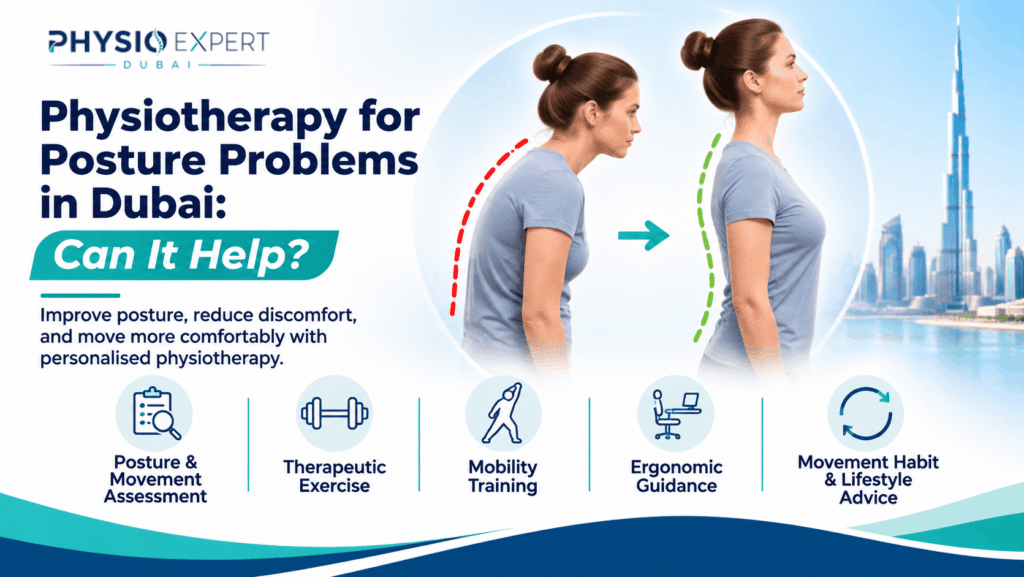
Posture describes how you position your body while sitting, standing, walking and moving. Everyday habits such as working at a desk, using a phone, driving for long periods or staying in one position can influence how comfortable your body feels throughout the day.
Poor posture is often blamed for neck pain, back pain and muscle tension. However, posture is not simply about keeping your spine perfectly straight. People naturally adopt different positions, and no single posture is ideal for everyone. Problems are more likely when a position is uncomfortable, maintained for too long or combined with limited movement and reduced physical capacity.
Posture physiotherapy in Dubai can help people experiencing posture-related discomfort by assessing movement, strength, mobility and daily habits. A physiotherapist can recommend practical adjustments and exercises based on your symptoms, activities and goals.
This guide explains common posture concerns, how physiotherapy may help, and what you can do to support comfortable movement throughout the day.
What Are Posture Problems?
Posture problems generally refer to body positions or movement habits that may contribute to discomfort, fatigue or difficulty performing certain activities.
Common posture concerns include:
- Rounded shoulders.
- Forward head posture.
- Increased upper-back rounding.
- Slouched sitting.
- Uneven weight distribution while standing.
- Prolonged positions that cause stiffness or discomfort.
These patterns are not automatically harmful. A person may have rounded shoulders or a naturally curved spine without experiencing pain. Posture should be considered alongside symptoms, movement capacity, strength, activity levels and individual anatomy.
Common Causes of Poor Posture
Posture is influenced by several factors, including daily activities, physical capacity and individual structure.
1. Prolonged Sitting
Many people spend long periods sitting at desks, in meetings or while commuting. Remaining in one position for an extended time may contribute to stiffness and discomfort, particularly when movement breaks are limited.
Rather than trying to maintain a rigid sitting position all day, it is often more useful to vary positions and take regular movement breaks.
2. Frequent Phone and Computer Use
Looking down at a phone or working with a poorly positioned screen may encourage sustained neck and upper-back positions.
Adjusting screen height, device position and work setup may help reduce discomfort, although ergonomic changes alone may not resolve persistent symptoms.
3. Reduced Strength or Endurance
Reduced strength or endurance in the trunk, shoulder and hip muscles may affect a person’s ability to maintain comfortable positions during daily activities.
This does not mean that weak muscles are always the cause of poor posture. A physiotherapist can assess whether strengthening is relevant to the individual’s symptoms and functional needs.
4. Limited Mobility
Restricted movement in the neck, upper back, shoulders or hips may make certain positions less comfortable.
Mobility exercises may be useful when assessment identifies a relevant limitation. Stretching is not required for every posture concern.
5. Habitual Movement Patterns
People often repeat the same positions throughout the day. Over time, these habits may influence how they move and where they experience discomfort.
Changing movement habits usually requires practical adjustments, regular activity and gradual practice rather than constant monitoring of body position.
Read More – How to Choose the Best Physiotherapy in Jumeirah, Dubai
Can Physiotherapy Help With Posture Problems?
Physiotherapy may help people with posture-related discomfort by improving movement options, strength, endurance and awareness of daily habits.
The goal is not to force the body into one perfect posture. Instead, treatment aims to help you move comfortably, tolerate daily activities and reduce symptoms where possible.
1. Posture and Movement Assessment
A physiotherapist may assess:
- Your usual sitting, standing and working positions.
- Neck, shoulder, back and hip mobility.
- Muscle strength and endurance.
- Movement during relevant daily activities.
- Symptoms associated with specific positions.
- Workstation and activity habits.
The assessment helps determine whether posture is relevant to your symptoms and which factors may be appropriate to address.
2. Therapeutic Exercise
Exercise may help improve strength, endurance and movement capacity.
Depending on the assessment, a programme may include exercises for the:
- Upper-back and shoulder muscles.
- Neck and shoulder girdle.
- Trunk and abdominal muscles.
- Hip and lower-limb muscles.
Exercises should be selected according to your physical needs and progressed gradually.
3. Mobility Training
If limited mobility contributes to discomfort, a physiotherapist may recommend targeted movement exercises for the neck, thoracic spine, shoulders or hips.
Mobility work should be comfortable and appropriate for the individual’s condition. Forcing a stretch or repeatedly moving into painful positions is not necessary.
4. Ergonomic Guidance
A physiotherapist can help you review your workstation and daily routine.
Practical changes may include positioning your screen at a comfortable height, supporting your feet, adjusting your chair and keeping frequently used items within easy reach.
Ergonomic adjustments should support comfort and movement rather than create a rigid posture that must be maintained all day.
5. Movement Awareness and Habit Changes
Physiotherapy may help you recognise positions or activities that aggravate symptoms and develop strategies to manage them.
This may include alternating between sitting and standing, taking brief movement breaks, changing how you carry objects or gradually increasing physical activity.
Common Posture Concerns and Physiotherapy Approaches
Forward Head Posture
Forward head posture describes a position in which the head sits forward relative to the trunk.
Some people with this posture experience neck discomfort or fatigue, while others have no symptoms.
Physiotherapy may include neck and upper-back strengthening, mobility exercises, movement breaks and adjustments to screen or device position when relevant.
Rounded Shoulders
Rounded shoulders describe a posture in which the shoulders rest forward relative to the trunk.
This position is common and does not automatically indicate a problem. If it is associated with discomfort or restricted movement, treatment may include shoulder and upper-back strengthening, mobility exercises and activity modification.
Slouched Sitting
Slouched sitting involves a relaxed, rounded position of the trunk while seated.
Slouching is not inherently dangerous, and sitting upright all day is not necessary. However, staying in one position for long periods may contribute to discomfort.
Changing positions regularly and building the capacity to tolerate different sitting postures may be more useful than trying to maintain one fixed position.
Increased Upper-Back Rounding
The upper back naturally curves forward. Some people have a more pronounced curve, which may be related to posture, spinal structure or medical conditions.
If the curve is pronounced, progressive, painful or associated with other symptoms, a medical assessment may be appropriate. Physiotherapy may help improve mobility, strength and function when clinically suitable, but it cannot necessarily change a structural spinal curve.
Posture Correction in Dubai: What Can You Do at Home and Work?
Small, consistent changes may help reduce discomfort and improve movement tolerance.
Adjust Your Workstation
Try to position your screen so that you can view it comfortably without repeatedly bending your neck. Keep your keyboard and mouse within easy reach and adjust your chair so your feet can rest comfortably.
There is no need to achieve a perfect ergonomic setup. Prioritise comfort and the ability to change positions.
Take Regular Movement Breaks
If you work at a desk, take brief breaks to stand, walk or move your shoulders and back.
Movement breaks can help interrupt prolonged static positions. The best schedule is one you can follow consistently.
Vary Your Positions
Alternate between sitting, standing and walking where practical. Avoid treating any single posture as the only correct way to position your body.
Build General Strength and Activity
Regular physical activity and appropriate strength training can improve overall physical capacity.
A physiotherapist can recommend exercises if you have pain, mobility limitations or uncertainty about which activities are suitable.
Exercises That May Be Used in Posture Rehabilitation
Exercise selection depends on the individual’s assessment. The following are examples of movements that may be included in some posture-related programmes, but they are not appropriate for every person.
Upper-Back Extension Mobility
Gentle upper-back movement may be used when thoracic mobility is limited.
The movement should remain comfortable and should not cause sharp pain, dizziness or radiating symptoms.
Shoulder Blade Strengthening
Exercises such as controlled rows or shoulder blade retraction may help improve upper-back and shoulder muscle endurance when appropriate.
The emphasis should be on comfortable, controlled movement rather than forcefully pulling the shoulders back throughout the day.
Neck Strengthening
Some people may benefit from targeted neck strengthening or endurance exercises.
These should be selected and progressed according to symptoms and assessment findings, particularly if neck pain, headaches or radiating symptoms are present.
Trunk Strengthening
Exercises that develop trunk strength and endurance may support daily activities and movement tolerance.
The appropriate exercise type and intensity depend on the person’s symptoms, physical capacity and goals.
If an exercise causes worsening pain, numbness, tingling or other unusual symptoms, stop and seek professional guidance.
Read More – Sports Physiotherapy in Dubai: When Should an Athlete See a Physio?
How Long Does Posture Physiotherapy Take?
The duration of physiotherapy depends on the reason for treatment, the presence of pain, daily activity demands and the individual’s response to rehabilitation.
Some people may benefit from a few sessions focused on education, exercise and practical adjustments. Others with persistent pain, significant mobility limitations or complex conditions may need a longer programme.
Progress is usually assessed through changes in symptoms, movement, strength, endurance and the ability to perform everyday activities—not simply whether a person appears to sit or stand differently.
When Should You See a Physiotherapist?
Consider seeking physiotherapy if you experience:
- Persistent neck, shoulder or back discomfort.
- Stiffness that affects work or daily activities.
- Pain associated with prolonged sitting or standing.
- Difficulty moving your neck, shoulders or upper back.
- Recurrent discomfort despite changing your workstation or activity habits.
- Uncertainty about suitable exercises or posture adjustments.
Seek prompt medical assessment if you develop severe or rapidly worsening pain, new weakness, significant numbness, problems with balance or coordination, or symptoms following a serious injury. New bladder or bowel control problems or numbness around the groin or saddle area with back pain require emergency assessment.
Read More – Physiotherapy for Sciatica in Dubai: Treatment and Recovery Guide
Why Choose Physio Expert Dubai for Posture Physiotherapy?
Posture-related concerns can have different causes and may require different treatment approaches. A personalised assessment can help identify whether symptoms are associated with movement habits, strength, mobility, workload or another condition.
At Physio Expert Dubai, physiotherapy may include posture and movement assessment, therapeutic exercise, mobility training and practical guidance for daily activities.
The aim is to help you improve comfort, build physical capacity and manage activities in a way that supports your individual needs.
Final Thoughts
Posture is not about holding your body in one perfect position. It is about having the strength, mobility and movement options to carry out daily activities comfortably.
Posture physiotherapy in Dubai may help address posture-related discomfort through individual assessment, exercise, ergonomic guidance and practical changes to daily habits. If persistent pain or stiffness is affecting your work or routine, a physiotherapist can help you understand your symptoms and identify appropriate next steps.
Frequently Asked Questions
1. Can physiotherapy correct poor posture?
Physiotherapy may help improve movement, strength, endurance and posture-related discomfort. It can also help you develop more comfortable daily habits. However, not every postural variation needs correction, and structural changes may not be reversible through exercise.
2. Does poor posture cause back and neck pain?
Posture may be one factor associated with discomfort, but pain is usually influenced by several factors. Prolonged static positions, stress, activity levels, sleep, physical capacity and medical conditions may also contribute.
3. How many physiotherapy sessions are needed for posture problems?
The number of sessions depends on your symptoms, goals and progress. Some people need a short course of guidance, while others may require longer rehabilitation.
4. Should I sit straight all day?
No. Maintaining one rigid posture throughout the day is not necessary. Changing positions regularly and taking movement breaks may be more helpful than trying to sit perfectly upright at all times.
5. Can posture exercises help with rounded shoulders?
Exercises may help improve strength, endurance and movement comfort when these are relevant to the person’s needs. Rounded shoulders are common and do not automatically require treatment.
6. Can posture physiotherapy help with headaches?
Some headaches are associated with neck pain or musculoskeletal factors. A physiotherapist may assess whether neck movement, muscle function or daily habits are relevant. Headaches can have other causes, so appropriate medical assessment is important when symptoms are new, severe or unusual.
7. Is poor posture permanent?
Not necessarily. Some posture habits can change with movement, exercise and practical adjustments. However, posture is also influenced by anatomy and structural conditions, which may not change through physiotherapy alone.
8. What is the best sleeping position for posture?
There is no single best sleeping position for everyone. A comfortable position that supports adequate sleep is generally a reasonable starting point. If sleep position consistently aggravates pain, a physiotherapist can help you explore adjustments.
9. Can I improve my posture without equipment?
Often, yes. General activity, movement breaks, appropriate strengthening and workstation adjustments can be done without specialised equipment. The right approach depends on your symptoms and physical needs.
10. When should posture-related pain be medically assessed?
Seek medical assessment if pain is severe, persistent, worsening or accompanied by symptoms such as fever, unexplained weight loss, new weakness, significant numbness or problems with balance. Urgent symptoms should not be attributed to posture without evaluation.
